
AI Product Photography for Beauty and Skincare Brands

Table of contents:
What is AI Photography? | Why Beauty And Skincare Brands Are Using AI? | How Realistic Is AI Photography for Beauty And Skincare? | AI Product Photography vs Traditional | Ready To Hire An AI Creative Director?
AI product photography has changed what is possible for beauty and skincare brands.
AI product photography has changed what is possible for beauty and skincare brands. For years, the visual gap between brands came down to one thing: budget. The brands at the top did not necessarily have better ingredients. Instead, they had high campaign budgets that funded full productions. Creative directors, photographers, models, set designers, hair and makeup artists, wardrobe stylists, on-location shoots, and everything in between.
That visual gap is closing, and it is closing fast.
Smart Brands Are Doing It Differently Now
Today, forward-thinking beauty and skincare brands are producing campaign imagery that looks just as luxurious as the biggest names in the industry. Small and mid-size brands can now achieve that same luxury look without spending thousands more on a full production team. They are working smarter, not spending more. No studio rentals, no production crews, no model fees, no props, no set design, and no location flights. As a result, a skilled AI creative director builds the editorial world your brand deserves at a fraction of what a traditional production team would charge.
Additionally, the brands doing this well are not choosing between AI product photography and traditional photography. They are using both strategically. A traditional photographer handles catalog work: clean lightbox images, multiple angles, and product shots for retailer submissions. An AI creative director, on the other hand, handles the campaign layer. That means seasonal storytelling, launch imagery, and the cohesive visual identity that makes a brand feel like a brand. Together, they give small and mid-size brands a complete visual system.
This article explains how it works and how to find the right mix for your brand.
What Is AI Product Photography?
AI product photography is the use of artificial intelligence tools, guided by professional creative direction, to produce campaign-quality imagery without a traditional production shoot.
AI product photography is not typing a prompt into an image generator and hoping for the best. Generic tools produce generic results. A professionally directed AI campaign, on the other hand, is built around your products, your brand’s visual identity, your target audience, and the specific story you want each campaign to tell.
Your product reference images are the foundation. From there, creative direction shapes the environment, lighting, styling, composition, and mood. Editing and quality control then bring everything to a finished standard. AI is one part of the workflow, not the whole of it.
EXPLORE RELATED ARTICLE → AI Product Photography for Ecommerce
EXPLORE RELATED ARTICLE → AI Product Photography for Jewelry Brands
Why Beauty and Skincare Brands Are Using AI Product Photography
Lower Production Costs
Brand campaigns are where the cost difference becomes hardest to ignore. A traditional campaign requires a full photo shoot production that often requires one to two brand photographers, a creative director, location rental, model casting, hair and makeup, wardrobe, equipment, licensing, and post-production. And a bill that could easily run anywhere from $10,000 to $50,000 for a single campaign.
Working with an AI creative director brings that investment down considerably. The cost structure shifts away from high per-shoot production expenses and toward something more consistent and scalable, a creative system that produces campaign-quality output across collections, seasons, and platforms without rebuilding the budget from scratch each time.
Faster Campaign Creation
From first concept to final delivered assets with a traditional photoshoot production team, you’re looking at a 2-4 months minimum timeline for a professional brand campaign
AI product photography for jewelry brands moves significantly faster. Once your brand creative system is established and your reference assets are in place, new campaign imagery can be turned around in days rather than months. In fact, for brands releasing multiple collections per year or producing content for a range of platforms simultaneously, that speed compounds quickly.
Shoot Anywhere. No Booking Required.
Location availability, rental fees, and licensing restrictions bind traditional campaign shoot locations. A sun-drenched Santorini terrace, a serene Japanese zen garden, a lush tropical rainforest, a minimalist Scandinavian spa. These are the environments luxury skincare brands dream of shooting in. They are not impossible in traditional production, but they entail significant logistics, travel costs, and lead times that most small- and mid-size skincare brands cannot justify for every collection.
With AI creative direction, location is a creative decision, not a production constraint. Every campaign can be set exactly where your brand story calls for, without a location scout, a permit, or a travel budget. Your summer collection can live in the south of France, and your holiday campaign can feel like a candlelit European estate. Everyday fine jewelry can be shot against the kind of effortless natural environments that take traditional productions weeks to secure.
EXPLORE RELATED ARTICLE → AI Brand Photography vs. Traditional
Can AI Create Realistic Beauty and Skincare Imagery?
Early AI imagery had recognizable limitations: skin that looked flat and plastic, hair that lacked natural variation and often merged oddly at the edges, hands and feet that were an immediate giveaway, labels that distorted, and glass that did not refract quite right. Those limitations are largely behind us.
Today, modern AI rendering has advanced to the point where textured surfaces look more lifelike than ever, and for the beauty and skincare category specifically, that advancement matters in very particular ways.
AI Campaign Model
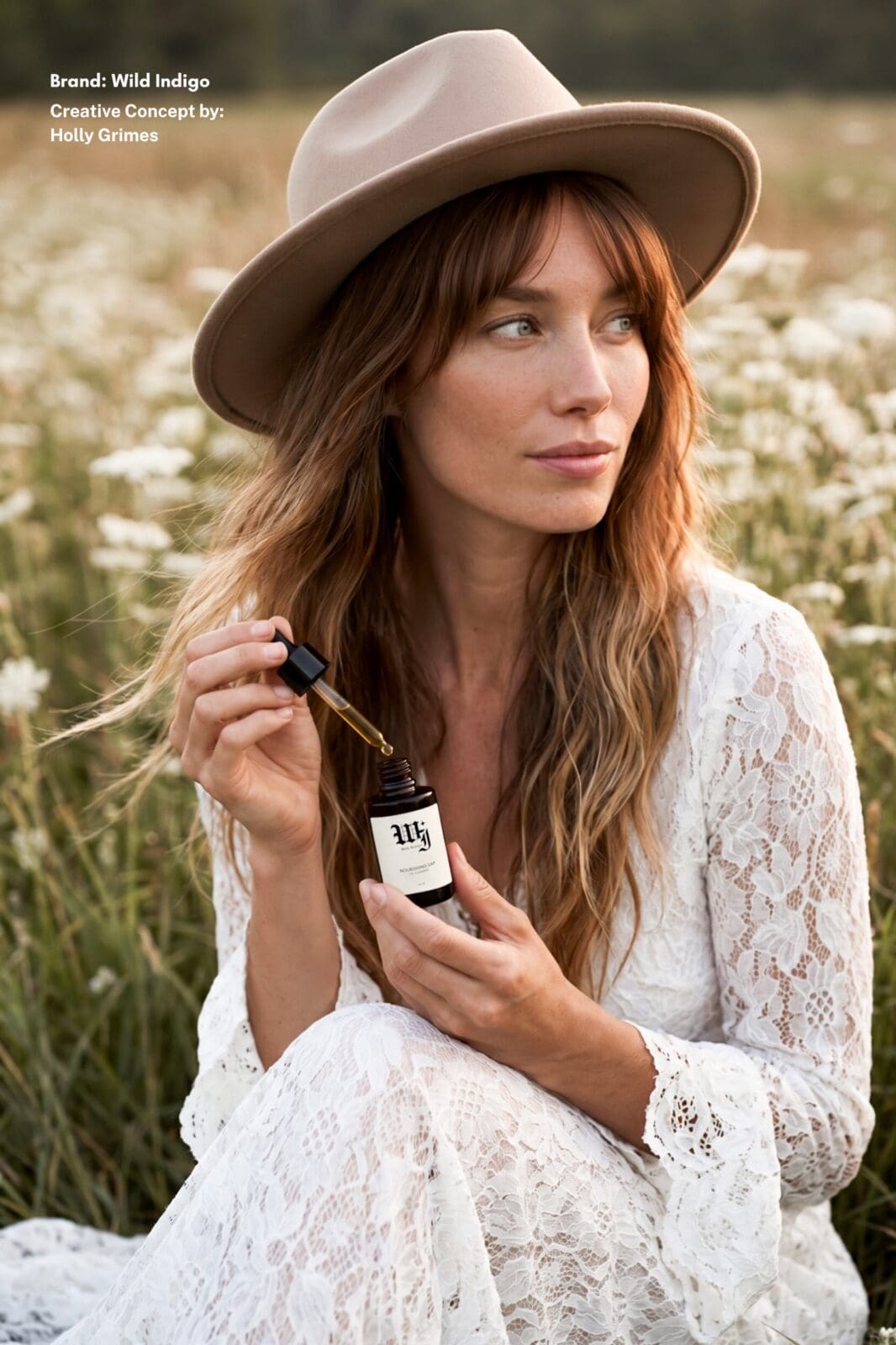
For brands that want a model featured in their campaign imagery, AI can now create a realistic, editorial quality model that feels intentional and on brand. Skin texture renders with genuine depth. Pores, hydration sheen, the slight translucency of well-moisturized skin, freckles, and the difference between dewy and matte finishes are all achievable with the right direction. Skin no longer looks processed or airbrushed into perfection. Instead, it looks like real skin caught in beautiful light, which is exactly what luxury skincare campaigns depend on.
Additionally, hair now renders with natural movement and dimension. Micro hairs around the hairline and individual strands at the part are visible at the campaign scale. Flyaways, soft waves, and the way hair falls naturally across a shoulder all contribute to imagery that feels lived-in rather than generated.
Glass, Refraction, and Bottle Rendering
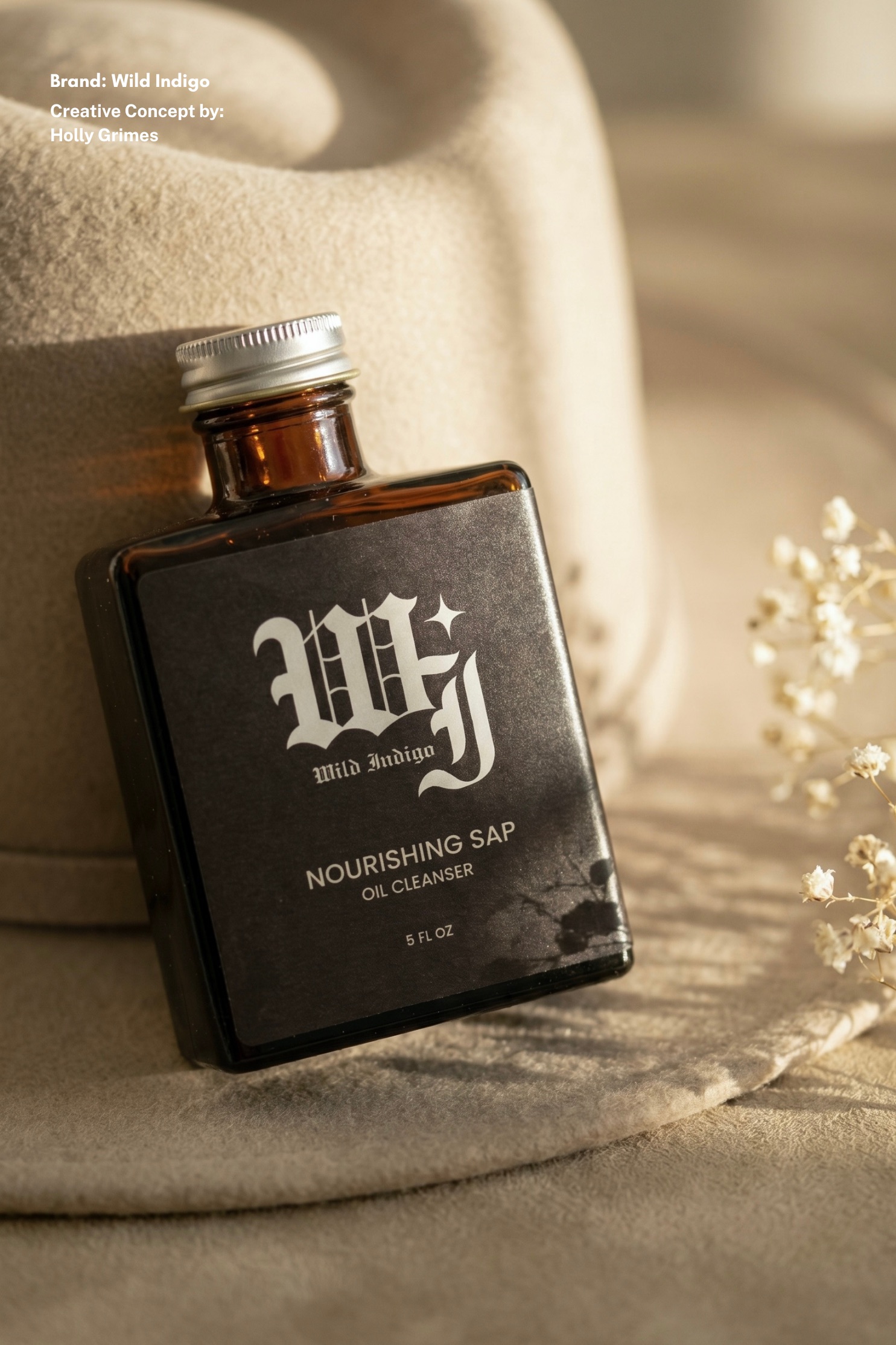
Skincare packaging requires precise rendering to look credible at campaign scale. Glass bottles, dropper tops, pump dispensers, and frosted or amber glass each interact with light differently, and modern AI now captures those distinctions accurately. For example, the gradient of a serum bottle from opaque base to translucent top, the way liquid catches light inside a clear dropper, and the subtle differences between matte and glossy finishes all render with a level of detail that holds up in final campaign imagery.
Beyond the bottle itself, labels have historically been one of the more demanding elements. Curved labels on round bottles, embossed text, foil finishes, and the way a label edge sits against the glass beneath it all require accuracy that early AI struggled to deliver consistently. However, with precise product reference images and skilled direction, those details now render cleanly at campaign scale.
Product Texture on Skin and Surface
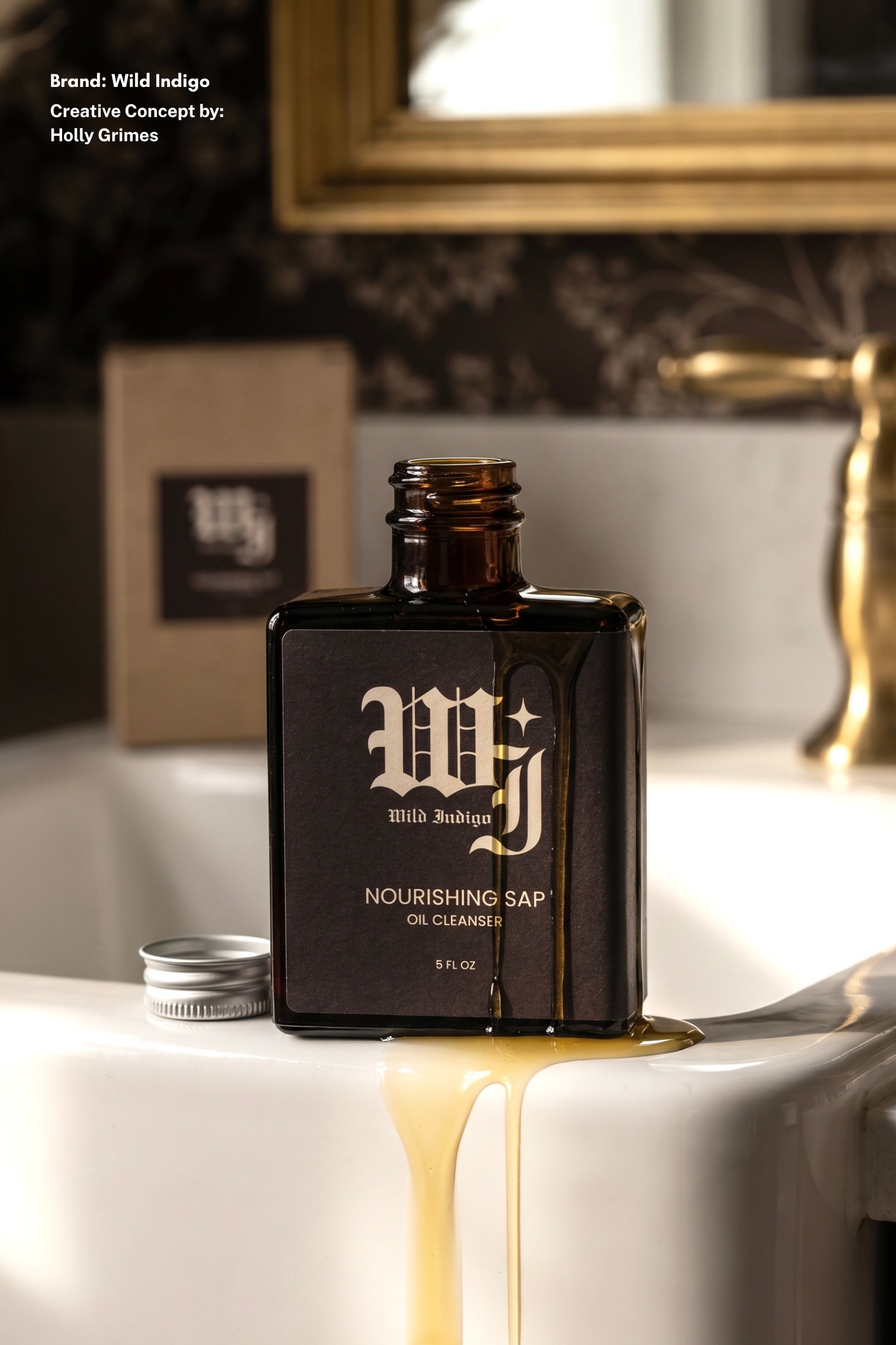
Serum consistency, the drag of a rich cream, a drop of facial oil catching light: the tactile qualities that make skincare imagery persuasive are no longer beyond AI’s reach. These sensorial details are what separate a product image from a campaign image. They are what make someone stop scrolling.
When a campaign image needs to show a product being applied, the rendering quality now supports that storytelling convincingly. A serum pressed into the skin shows the slight resistance of the formula. A rich cream leaves a visible trail across the back of a hand. A facial oil catches light in a way that communicates luxury before a single word is read. Products resting on surfaces render with the same level of realism. That tactile quality is what luxury skincare campaigns have always been built on. AI can now deliver it.
The Tool Is Only as Good as the Direction Behind It
Realism is not automatic. It comes from skilled creative direction, accurate product references, careful styling decisions, and rigorous editing. The AI is the tool. Therefore, the quality is the result of the person directing it. Ultimately, professionally directed AI campaigns can be genuinely difficult to distinguish from traditional photography, and poorly directed ones make that obvious immediately.
AI Product Photography for Beauty and Skincare vs Traditional
Traditional photography is still the stronger choice for high-volume catalog work. If you need clean, consistent light box imagery of every piece from multiple angles for your Shopify product pages, a traditional photographer with a controlled studio setup will produce that content more efficiently and at a lower per-image cost than any other method. In fact, that kind of documentation work is where traditional photography excels.
AI creative direction owns the campaign territory. Brand campaigns, lifestyle imagery, editorial scenes, social content, and seasonal variations are where AI-directed workflows produce results that meet or exceed traditional production quality at a fraction of the cost and timeline.
For most growing beauty and skincare brands, the right answer is not choosing between them. It is knowing which jobs belong to each.
The Smartest Approach: Using Both
Use a traditional photographer for your catalog documentation session to get your ecommerce website up and running. Clean, consistent shots of every piece for your product pages. Then bring in an AI creative director for everything built on top of that foundation: campaign imagery, model lifestyle shots, seasonal content, new launches, and social assets.
Strong fit:
- Beauty and skincare brands investing in campaign-level storytelling and editorial imagery
- Small and mid-size brands that want luxury-level campaign aesthetics without a luxury production budget
- Brands with frequent product launches that need cohesive campaign imagery each time
- Brands that need ongoing seasonal content throughout the year
Less suitable:
- Ecommerce brands with large SKU libraries that primarily need clean, multi-angle lightbox shots for product pages.
- Clinical before-and-after photography
- Ingredient demonstration or scientific claim imagery
- Regulatory or compliance photography
Ready to See What An AI Creative Director Can Do for Your Brand?
At Presley and Poppy, we help beauty, wellness, fashion, and hospitality brands create campaign-quality visuals that compete with the biggest names in their space, without the six-figure production budget.
If you are curious whether AI creative direction is the right fit for your next campaign, product launch, or content strategy, let’s chat!
Where creative direction begins →
And if you want to explore the full range of services, from website design to AI brand campaign offerings and partnerships, you can view all services here: presleyandpoppy.com→
