
AI Product Photography for Jewelry Brands
Table of contents:
What is AI Product Photography? | Why Jewelry Brands Are Using AI | What AI Does Well | What AI Needs Help With | AI Product Photography Vs Traditional | Why DIY AI Photography Works Against Your Brand | Common Questions About AI Product Photography | Ready to See what a Creative Director Can Do for Your Brand?
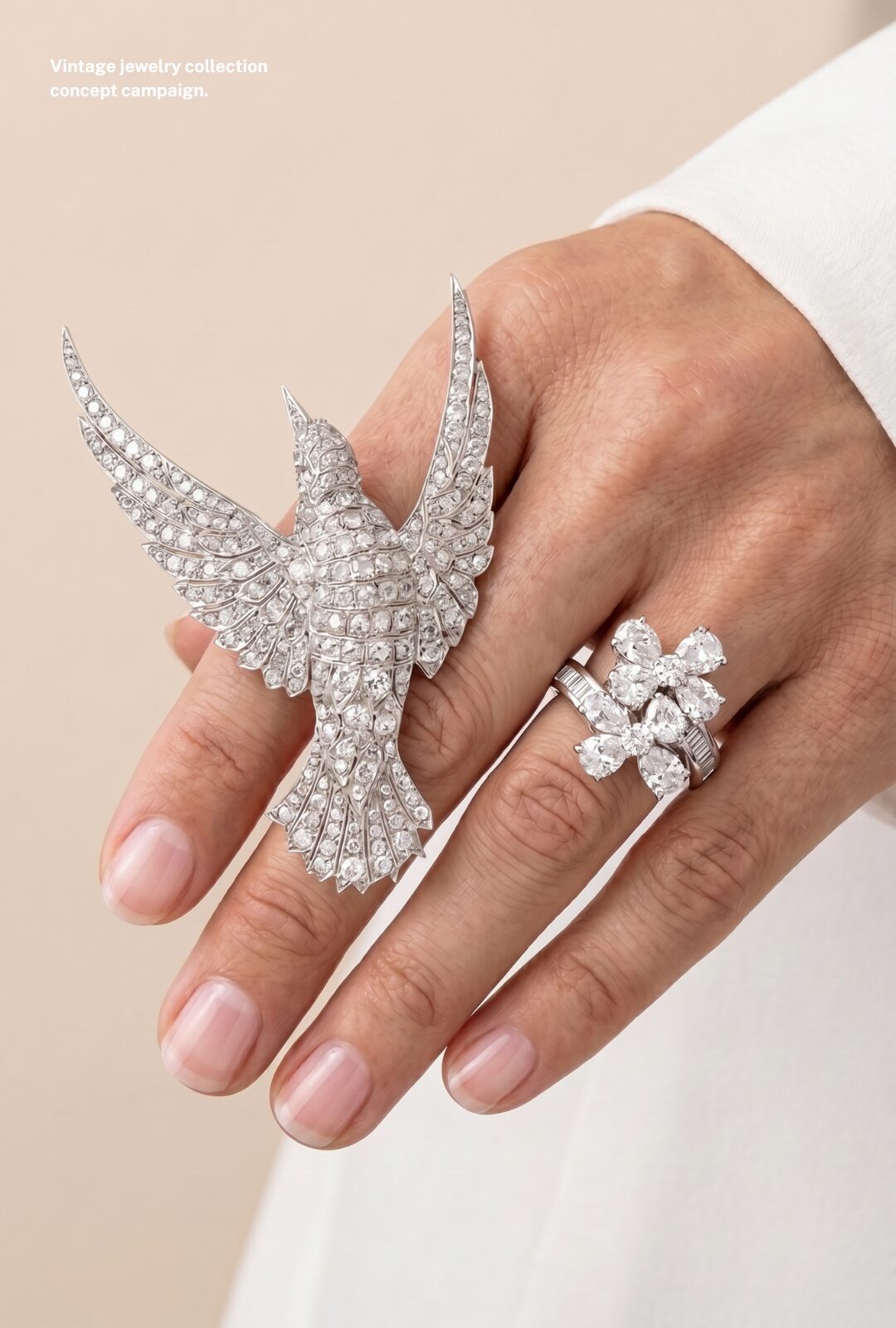
Jewelry is one of the most visually demanding product categories in ecommerce. The weight of a pendant, the way a stone catches light, the delicate proportions of a stacking ring on an actual hand. These are not supporting details for a buyer. They are the decision itself.
And yet most independent jewelry brands are shooting against a white background and calling it a campaign.
That gap is exactly where AI product photography is creating a new opening. Smaller brands are now producing editorial-quality imagery at a fraction of traditional production costs, and doing it on a pace that keeps up with new collections, seasonal content, and platform-specific creative demands.
This article breaks down what AI product photography is, where it works exceptionally well for jewelry, where you still need a camera and a real hand, and how professional AI creative direction compares to hiring a traditional photography team.
What is AI Product Photography
AI product photography uses artificial intelligence tools to generate, composite, or enhance images of physical products without a traditional photo shoot. Depending on the tools and workflow involved, it can produce anything from clean product cutouts on styled backgrounds to full editorial scenes with models, environments, and mood lighting.
For jewelry brands, this typically means providing high-resolution reference photos or 3D assets of each piece, then working within an AI-directed creative workflow to produce campaign imagery, lifestyle scenes, social content, and seasonal variations. If you choose to style your pieces on an AI model, a reference image of the actual size of the piece is needed for size cohesion throughout the campaign.
Done well, it is a fully art-directed image that reflects your brand’s visual identity — built without renting a studio, booking a model, or coordinating a production team, saving you thousands on your next brand campaign.
Why Jewelry Brands Are Using AI for Their Product Photography
The Visual Bar Is Higher Than You Think
The global jewelry market hit $348 billion in 2025, with online jewelry sales growing at 13.8% annually. But growth at the market level does not automatically translate into growth for individual brands. The structural issue that holds most jewelry ecommerce stores back is not traffic. It is visual content.
Research consistently points to one core conversion problem: buyers cannot get enough visual confidence to commit. 60 percent of online jewelry buyers hesitate to purchase when they cannot see a piece worn in context. A white-background product shot has been the industry default for years. It is no longer enough.
Research shows that 93% of shoppers prioritize visual appearance above all other factors when making a purchase decision. For jewelry, that is not a marketing insight; it’s a survival requirement.
Lower Production Costs
Brand campaigns are where the cost difference becomes hardest to ignore. A traditional jewelry campaign requires a full photo shoot production that often requires one to two photographers who specialize in reflective surfaces, a creative director, location rental, model casting, hair and makeup, wardrobe, equipment, licensing, and post-production. And a bill that could easily run anywhere from $10,000 to $50,000 for a single campaign.
Working with an AI creative director brings that investment down considerably. The cost structure shifts away from high per-shoot production expenses and toward something more consistent and scalable, a creative system that produces campaign-quality output across collections, seasons, and platforms without rebuilding the budget from scratch each time.
Faster Campaign Creation
From first concept to final delivered assets with a traditional photoshoot production team, you’re looking at a 2-4 months minimum timeline for a professional brand campaign
AI product photography for jewelry brands moves significantly faster. Once your brand creative system is established and your reference assets are in place, new campaign imagery can be turned around in days rather than months. In fact, for brands releasing multiple collections per year or producing content for a range of platforms simultaneously, that speed compounds quickly.
Shoot Anywhere. No Booking Required.
Traditional campaign shoots are bound by location availability, rental fees, and licensing restrictions. A coastal cliffside, a Parisian interior, a sun-drenched desert landscape. These are not impossible for a traditional production, but they come with logistics, cost, and lead time that most independent jewelry brands cannot justify for every collection.
With AI creative direction, location is a creative decision, not a production constraint. Every campaign can be set exactly where your brand story calls for, without a location scout, a permit, or a travel budget. Your summer collection can live in the south of France, and your holiday campaign can feel like a candlelit European estate. Everyday fine jewelry can be shot against the kind of effortless natural environments that take traditional productions weeks to secure.
EXPLORE RELATED ARTICLE → AI Product Photography for Ecommerce
EXPLORE RELATED ARTICLE → AI Product Photography for Beauty and Skincare Brands
Where AI Shines with Jewelry Photography
Metal, Shine, and Surface Rendering
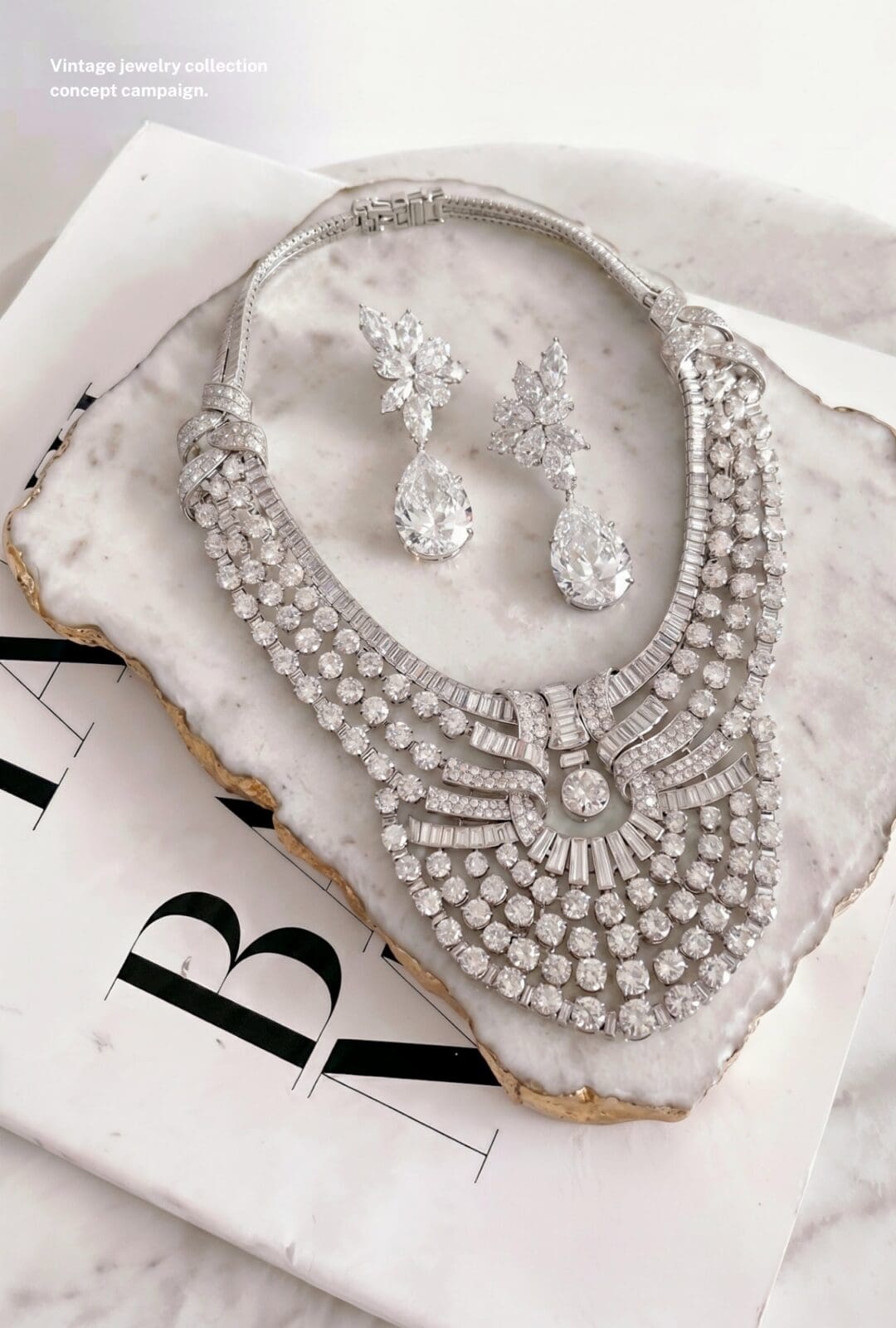
AI tools have become remarkably capable at rendering reflective surfaces, which have historically been the most technically demanding aspect of jewelry photography. Gold, silver, rose gold, and platinum each carry distinct light behavior. A well-directed AI workflow can produce imagery that captures these material qualities consistently.
For smooth, high-polish pieces like bands and simple chains, results tend to be particularly strong.
Packaging and Brand Asset Photography
AI handles solid-surface packaging cleanly and reliably. Boxes, pouches, bags, and cases all render well, and logo placement on packaging is something AI has become particularly strong at. Text, monograms, and brand marks sit accurately on the surface and material without the distortion that earlier tools struggled with. Combined with product imagery, this gives you a complete set of brand assets for marketing, retail, and digital without separate production investments.
Campaign Variations and Seasonal Content
Jewelry brands with multiple collections per year feel the production burden more than almost any other category. Holiday campaigns, Valentine’s Day drops, summer lookbooks, and bridal season are each a distinct creative need that traditionally means assembling a production team all over again. AI creative direction compresses all of that into a single workflow, producing campaign-quality imagery for every collection without rebuilding the process from scratch each time.
AI Campaign Models
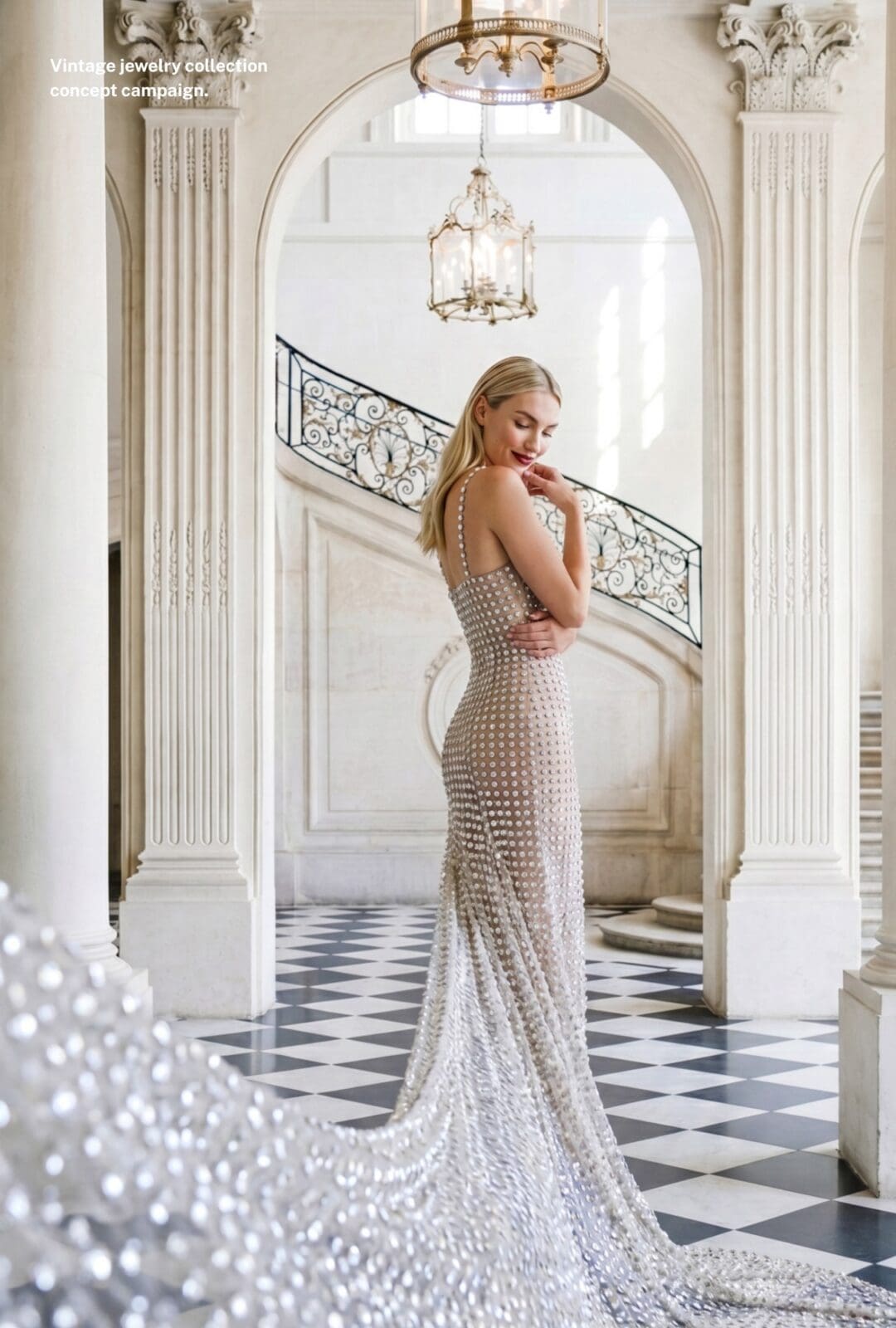
An AI creative director can create an exclusive model for your brand, designed around your aesthetic, your target demographic, and creative point of view. That model will consistently show up across every campaign, every platform, and every season without casting calls, scheduling conflicts, or day rates. For brands that want signature continuity, this is a great option as the same model anchors every launch and builds recognition over time. For brands that prefer to keep things fresh, a new model can be designed for each new collection. Ultimately, the choice is yours, and having that flexibility built into every campaign is a distinct advantage.
Where AI Still Falls Short with Jewelry Photography
AI Needs Assistance with Jewelry Dimensions & Diamond Details
Before any campaign imagery is built, AI needs one thing a skincare or candle brand never has to think about: a sense of scale. Jewelry has no inherent visual proportion. A pendant could be the size of a thumbnail or a quarter. A ring could sit flush to the finger or stack well above it. Without a reference, AI will make assumptions that may not reflect your actual pieces.
Pro Tip: Before your first campaign, have someone from your team wear each piece and photograph it in natural light against a neutral background. This gives your AI creative director the proportional reference needed to represent every piece accurately across all campaign imagery. For diamond pieces, include an ultra-close macro shot of the stone. Capturing the mirrors within the diamond and the depth of the setting in that reference image is what allows those details to carry through into the final campaign result. The sharper the reference, the stronger the output.
AI Product Photography For Jewelry Brands vs. Traditional
Traditional photography is still the stronger choice for high-volume catalog work. If you need clean, consistent light box imagery of every piece from multiple angles for your Shopify product pages, a traditional photographer with a controlled studio setup will produce that content more efficiently and at a lower per-image cost than any other method. In fact, that kind of documentation work is where traditional photography excels.
AI creative direction owns the campaign territory. Brand campaigns, lifestyle imagery, editorial scenes, social content, and seasonal variations are where AI-directed workflows produce results that meet or exceed traditional production quality at a fraction of the cost and timeline.
For most growing jewelry brands, the right answer is not choosing between them. It is knowing which jobs belong to each.
The Smartest Approach: Using Both
Use a traditional photographer for your catalog documentation session to get your ecommerce website up and running. Clean, consistent shots of every piece for your product pages. Then bring in an AI creative director for everything built on top of that foundation: campaign imagery, model lifestyle shots, seasonal content, new launches, and social assets.
EXPLORE RELATED ARTICLE → AI Brand Photography vs. Traditional
Why DIY AI Photography Works Against Your Jewelry Brand
AI tools are more accessible than ever, and the temptation to use them independently is understandable. The reality is that unsupervised AI-generated jewelry imagery tends to look flat. The lighting feels off, the metal lacks depth, and the overall image has a quality that buyers cannot always name but immediately sense.
Working with a creative director, however, changes the outcome entirely. The expertise to extract photorealistic results from AI, the judgment to know when an image is truly campaign-ready, and the brand strategy to ensure every asset builds toward a cohesive visual identity are not things a tool provides on its own.
It also saves considerable time and money. The hours spent generating, reviewing, and discarding images that do not meet the standard add up quickly. As a result, the investment in professional direction pays for itself before the campaign ever goes live.
AI Product Photography for Jewelry Brands FAQ
Will My Brand Images Look Generic?
DIY AI tools often produce generic, inconsistent imagery because they lack a cohesive creative vision. Professionally directed AI campaigns are built around your brand’s unique visual identity—from your color palette and aesthetic references to your target audience and overall positioning. Every creative decision is intentional, resulting in imagery that feels as cohesive and elevated as a professionally art-directed photoshoot. AI is simply the tool. Exceptional results come from the creative direction behind it.
Do I Own the Images?
Ownership structures vary depending on who you work with. Some creative directors, much like traditional photographers, retain rights to the images they produce, meaning you may be restricted from editing, filtering, or manipulating the final assets without permission. Others assign full ownership to the brand at delivery. Before any project begins, ask directly about image rights and review your contract carefully. It is one of the most important questions to get on the table early.
Can I Use AI Images in Paid Ads?
Generally, yes, though policies vary by platform and continue to evolve. As of now, most major advertising platforms permit AI-generated imagery in paid campaigns.
Ready to See What an AI Creative Director Can Do for You?
At Presley and Poppy, we help beauty, wellness, fashion, and hospitality brands create campaign-quality visuals that compete with the biggest names in their space, without the six-figure production budget.
If you are curious whether AI creative direction is the right fit for your next campaign, product launch, or content strategy, let’s chat!
Where creative direction begins →
And if you want to explore the full range of services, from website design to AI brand campaign offerings and partnerships, you can view all services here: presleyandpoppy.com→
